Navigate All Collections Chords Guitar Minor chord family

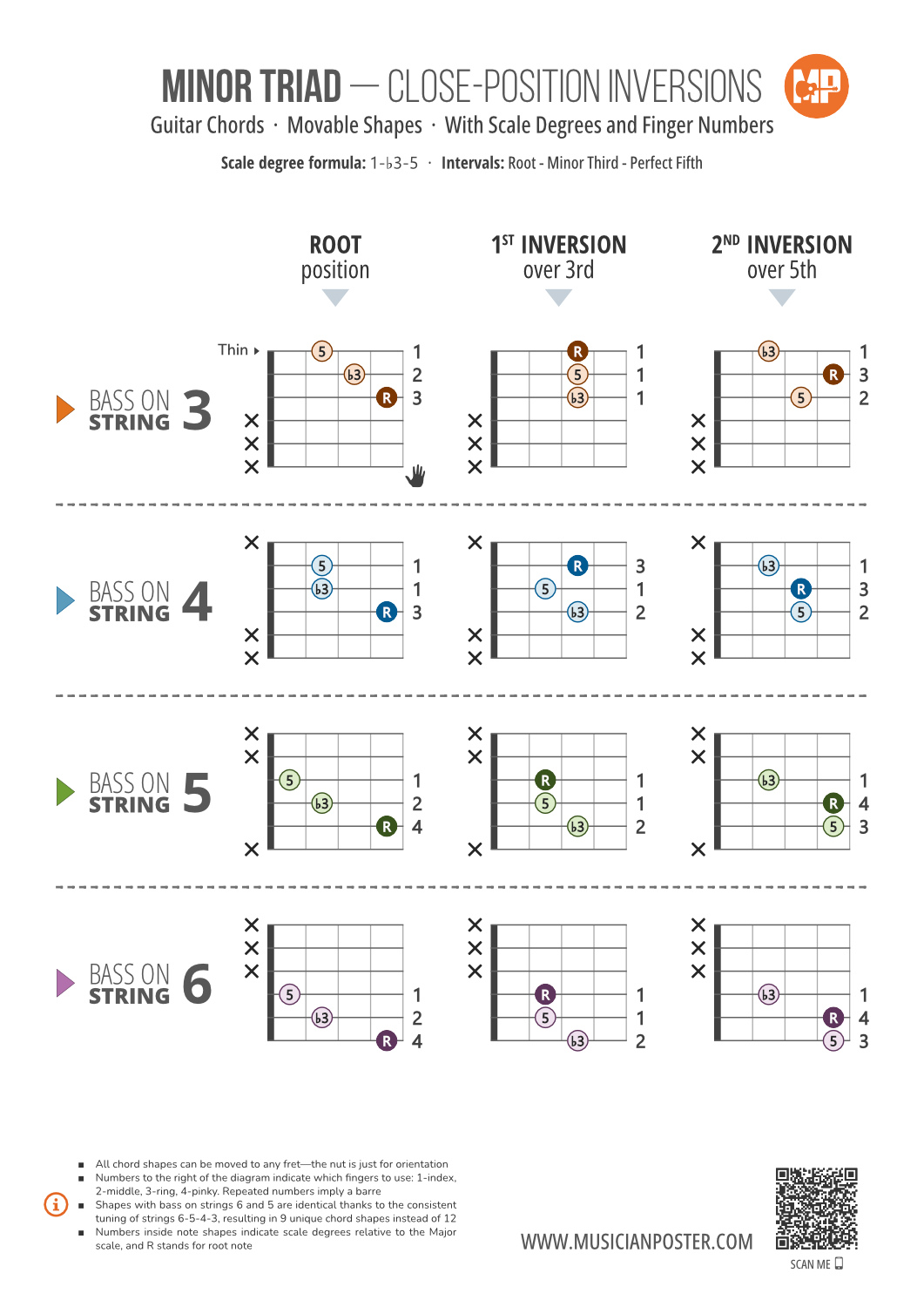
The charts show minor triad inversions in close-position across all adjacent 3-string groups on the guitar. The chord shapes are labeled using scale degrees, with a hybrid variation that also includes finger numbers.

A minor triad consists of three tones: the root, minor 3rd, and perfect 5th. In close position, these chord tones are arranged as closely together as possible, without spreading notes across octaves (which would then be referred to as an open voicing or spread voicing). Each inversion contains the same three notes in a different order, which changes the bass note while preserving the chord quality. The inversion with the 3rd in the bass is called the 1st inversion, while the inversion with the 5th in the bass is called the 2nd inversion.

These close-position triads provide one of the most fundamental and practical systems for understanding harmony on the guitar. Because each shape contains only the three essential chord tones, the relationships between inversions, intervals, and fretboard positions become easier to see, hear, memorize, and apply in real playing situations. The compact 3-string shape also makes these voicings efficient and useful for voice leading, chord melody, and improvisation.

How You Can Use This Chart

  • Learn all inversions of a minor triad on any adjacent 3-string group (1-3, 2-4, 3-5, 4-6).
  • Understand how each inversion of a basic minor triad is built exclusively from its three essential tones (root, 3rd, 5th) without any extra or duplicated notes.
  • See how each inversion is positioned on the fretboard in relation to the other inversions.
  • Learn multiple playable locations for the same triad across the neck.
  • Use close-position chord shapes as compact, efficient, easy-to-play and control voicings.
  • Build a foundation for wider voicings such as drop voicings and extensions by first becoming comfortable with the simplest close-position system and focusing on the most fundamental chord structure.
  • Train your ear to recognize chord quality and inversions by sound, as close-position voicings make interval relationships more apparent.
  • Use the 3-string limitation as a powerful learning tool to develop harmonic understanding and interval-based thinking instead of relying on fixed shapes, chord names, or full 6-string chords.
  • Use close-position triads as a reliable fallback when you are unsure how to play more complex chord voicings.

Chart Features With Practical Learning Benefits

  • All String Sets: Covers all playable close-position triads on string groups 1-3, 2-4, 3-5, and 4-6, giving you full fretboard coverage.
  • Two Learning Layouts: Charts come in two visualizations: one maps the inversions across a continuous fretboard layout, which allows you to understand them in context, visually track how chord shapes move, and play the same chord with different bass notes, while the other displays each inversion as an individual diagram for a more focused view. Just choose whichever layout works best for you.
  • Matches Your Viewing Angle: Chord diagrams are often shown vertically with the nut at the top, which doesn't match how the fretboard actually looks when you're holding the guitar. Charts with separated shapes feature horizontal diagrams with the nut on the side, matching your real point of view on the fretboard.
  • Movable: You can take any shape and move it anywhere on the fretboard to get the chord with the exact bass note you want.
  • Interval-Based Thinking: The diagrams are labeled with scale degrees so you can identify which chord tone (root, 3rd, or 5th) is under each finger when the chord is inverted. This gives you knowledge about the harmonic function of each tone inside the triad, which you can use to adjust the voicing in real time to fit your musical situation.
  • Theory + Execution: A chart with a hybrid layout gives you the best of both worlds by combining scale degrees with beginner-friendly finger numbers. You have the advantage of seeing each chord tone in terms of its harmonic function, while simultaneously seeing finger numbers shown alongside them to indicate which fingers to use. This dual-presentation approach lets you shift your focus between theoretical understanding and physical execution without ever needing to look up a different chart.
  • Self-Contained: Each chart stands on its own, with clear headers and footers that give you full context. Even when you print it, you always know exactly what you're looking at.
  • Fretboard Navigation: In the continuous layout, fret numbers are shown above the diagram, helping you locate your position on the fretboard and move around it more easily.
  • Color-Coding: Shapes have different colors to help you focus on one shape at a time.

Details

Poster type electronic
Poster language English
Paper size format A4 (ISO 216)

What is included

Poster, printable PDF 3 pc
Poster, grayscale (B/W), printable PDF 3 pc

Meta

Date added May 19, 2026
Version 1.0

0 Comments

To leave a public comment you need to log in to the system