
You are currently viewing 3 charts from a 32-page collection. The complete Musician Poster learning system includes more than 1800 printable pages organized into 14 collections, each focused on a particular topic or challenge.

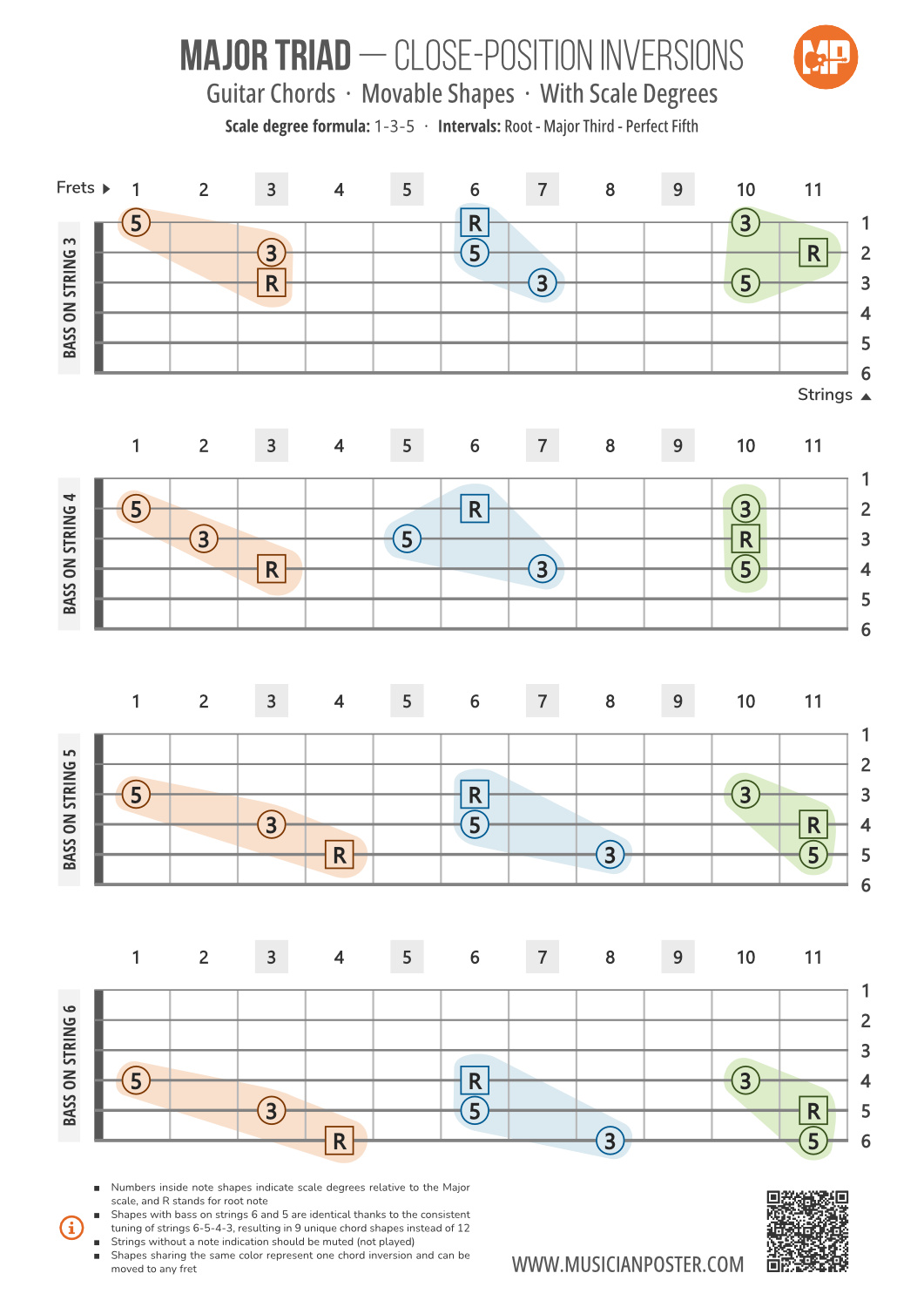
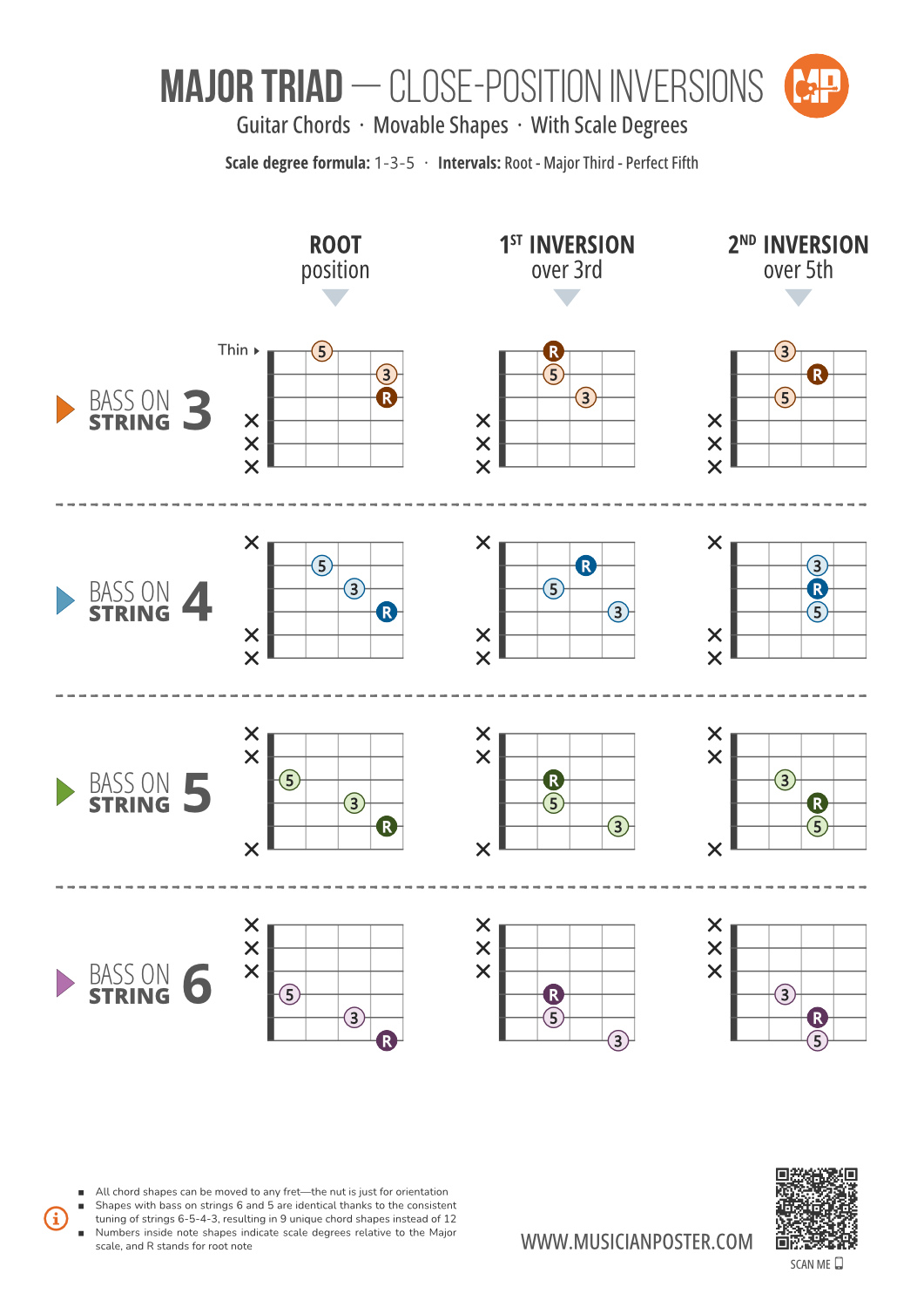
The charts show major triad inversions in close position across all adjacent 3-string groups on the guitar. The chord shapes are labeled using scale degrees, with a hybrid variation that also includes finger numbers.
A major triad consists of three tones: the root, major 3rd, and perfect 5th. In close position, these chord tones are arranged as closely together as possible, without spreading notes across octaves (which would then be referred to as an open voicing or spread voicing). Each inversion contains the same three notes in a different order, which changes the bass note while preserving the chord quality. The inversion with the 3rd in the bass is called the 1st inversion, while the inversion with the 5th in the bass is called the 2nd inversion.
These close-position triads provide one of the most fundamental and practical systems for understanding harmony on the guitar. Because each shape contains only the three essential chord tones, the relationships between inversions, intervals, and fretboard positions become easier to see, hear, memorize, and apply in real playing situations. The compact 3-string shape also makes these voicings efficient and useful for voice leading, chord melody, and improvisation.
You've just downloaded a so-called .zip archive file. It's a way of conveniently distributing multiple files so you didn't have to download one by one. It contains several files inside but to view its content you need to extract (unzip) it.
Every modern operating system comes with a program that is capable of unpacking such archive files so you don't have to download, install and even open any additional software. Click on the downloaded file to invoke its context menu and look for Extract option. Click that and all files which reside in the zip file will be unarchived into a single directory to your device. Navigate to the extracted folder and look for the poster PDF.
Should you need any assistance with opening the file contact me and I will gladly help you out.
| Poster type | electronic |
|---|---|
| Poster language | English |
| Paper size format | A4 (ISO 216) |
| Poster, printable PDF | 3 pc |
|---|---|
| Poster, grayscale (B/W), printable PDF | 3 pc |
| Date added | May 15, 2026 |
|---|---|
| Version | 1.0 |


0 Comments